


A BRONX TALE: THE ORIGINAL ONE MAN SHOW Blu-ray Review: Chazz Palminteri Brings the Bronx Home

Purchase at MovieZyng.com by clicking the image above
by John Larkin
One of the great values of physical media is its ability to preserve a performance that might otherwise disappear with time. That is why I am so happy that A BRONX TALE: THE ORIGINAL ONE MAN SHOW has finally been filmed and given a quality home-video release. Chazz Palminteri has been performing this legendary show on and off since its Los Angeles debut in 1989, yet many admirers of the 1993 film have never had the opportunity to experience the original work onstage. This Blu-ray finally makes the production available to those who were never able to attend one of Palminteri’s live performances, while giving longtime admirers the opportunity to own and revisit it whenever they choose.
Palminteri’s journey from struggling actor to the creator of A BRONX TALE remains one of the most inspiring stories in modern show business. A fellow Bronx native, he moved to Los Angeles in the 1980s and began finding guest roles on television, but the substantial film opportunities he wanted remained elusive. Running out of money, he took a job working the door at an exclusive club in Beverly Hills. One night, he refused to admit a rude guest who turned out to be the enormously powerful talent agent Swifty Lazar. Lazar told Palminteri that he would be fired within 15 minutes, and he was.
Back in his apartment, Palminteri remembered something his father had always told him: “The saddest thing in life is wasted talent.” If no one was willing to give him a great role, he decided, he would write one for himself. He began with a short monologue about a killing he had witnessed as a nine-year-old boy in the Bronx. He performed the developing material for his theater workshop, writing new sections each week, testing them in front of an audience and discarding anything that did not work. After approximately ten months, he had shaped the material into a tightly constructed 90-minute one-man play.
The resulting production quickly became one of the most talked-about shows in Los Angeles. Hollywood studios recognized its potential as a motion picture, but their offers came with conditions. Palminteri could sell the material, but the studios did not want the unknown actor to write the screenplay or portray Sonny. Even as the offers reportedly climbed into seven figures, he refused to surrender the story that had come directly out of his own life.
Then Robert De Niro attended the play.
De Niro recognized that Palminteri had essentially created a movie onstage. More importantly, he understood that its authenticity could not be separated from the man who had lived it. De Niro agreed that Palminteri should write the screenplay and play Sonny. In return, De Niro would make his directorial debut and portray Lorenzo, Calogero’s hardworking father. Their agreement was sealed with a handshake, and the resulting 1993 film became an enduring American classic.
For anyone unfamiliar with the story, A BRONX TALE is an autobiographically inspired account of Palminteri’s upbringing near East 187th Street and Belmont Avenue during the 1960s. Nine-year-old Calogero witnesses local mob boss Sonny shoot and kill a man during a dispute over a parking space. When the police ask Calogero to identify the gunman, the boy refuses. That decision brings him to Sonny’s attention and gradually into his orbit.
Calogero soon finds himself caught between two competing father figures. Lorenzo, his biological father, is a bus driver who believes in honest work, personal responsibility and the quiet dignity of providing for one’s family. Sonny represents power, money, fear and the seductive belief that respect can be seized rather than earned. Both men genuinely care about the boy, but each offers him a completely different vision of masculinity and adulthood.
This conflict is the heart of A BRONX TALE. Although the story is filled with mobsters, neighborhood characters and colorful street names, it is not finally about organized crime. It is about the moral education of a child. It asks what strength really looks like, whether it resides in the man everyone fears or in the man who gets up each morning and goes to work. It is also about wasted potential, prejudice and the decisions that slowly determine what kind of person someone will become.
The remarkable element of the stage version is that Palminteri portrays all 18 characters himself. There are no costume changes to announce that one person has left and another has entered. Instead, he differentiates them through posture, rhythm, vocal pitch, facial expression and the placement of his body onstage. A shift of his shoulders, a change in the direction of his eyes or a new position of his hands is sometimes all he needs to transform himself. Palminteri has described how every vocal register and physical gesture must be carefully controlled, especially during scenes in which three or four characters appear to be speaking to one another.
It is a truly remarkable feat of acting. Palminteri does not merely imitate these people or present them as a collection of amusing Bronx personalities. He creates a whole neighborhood. Calogero, Lorenzo, Sonny, Calogero’s mother and the various wise guys all seem to occupy distinct physical spaces around him. Even familiar characters such as Eddie Mush, Frankie Coffeecake and JoJo the Whale emerge as individuals rather than caricatures. Once the performance finds its rhythm, it becomes easy to forget that only one actor is standing on the stage.
The simplicity of the production is one of its greatest strengths. The staging is spare, with a streetlamp, the suggestion of a brownstone and the neighborhood bar providing the physical outline of the world. Music, sound effects and carefully controlled lighting help establish the atmosphere, but Palminteri remains the production’s principal special effect. The Bronx is summoned through language, gesture and memory. He describes the streets so vividly that the audience supplies the buildings, automobiles, storefronts and crowds for itself.
More than 35 years after the play’s original production, Palminteri’s age gives the material an added reflective quality. He is no longer simply dramatizing the events that launched his career. He is looking back across a lifetime at the people, decisions and accidents that made that career possible. The energy and physical precision are still there, but so is the understanding of a man who has had decades to contemplate what his father and Sonny each gave him.
The show is often very funny, but its humor never diminishes the danger surrounding Calogero. Palminteri can move from an exaggerated neighborhood character into a moment of genuine fear without breaking the spell. The later sections, including Calogero’s relationship with Jane and the racial hatred surrounding them, expand the story beyond a contest between an honest father and a charismatic criminal. They reveal a neighborhood whose close bonds can provide protection but can also encourage ignorance, tribalism and violence.
Watching the play after knowing the 1993 film also reveals how faithfully De Niro and Palminteri translated the material to the screen. Many of the film’s most memorable scenes, characters and lines were already present in the stage version. Yet the play never feels like an outline awaiting its eventual cinematic completion. It is a complete work with its own dramatic identity.
The film naturally has advantages that a one-man production cannot reproduce. De Niro could place the audience inside a fully populated neighborhood, use music and locations to evoke the period, and draw memorable performances from Francis Capra, Lillo Brancato, Kathrine Narducci, Taral Hicks and the rest of the ensemble. The stage version offers something different and, in its own way, equally powerful.
Because Palminteri plays Calogero, Lorenzo and Sonny, the central conflict feels as though it is occurring inside one man’s memory. The boy, the honest father and the dangerous mentor all emerge from the same body. We are not only watching what happened to Calogero. We are watching an adult return to the voices that formed him and consider which parts of them he has carried through life.
That intimacy gives the play an emotional force distinct from the film. The 1993 adaptation is a beautifully realized piece of cinema. A BRONX TALE: THE ORIGINAL ONE MAN SHOW feels more like a confession, an oral history and a piece of living neighborhood folklore. Palminteri is standing before us and telling us what he saw, what tempted him, what frightened him and what ultimately saved him.
The filmed presentation wisely respects the theatrical nature of the material. It does not attempt to disguise the production as a conventional motion picture. The camera allows us to appreciate Palminteri’s complete physical performance while moving close enough to capture the smaller facial changes that distinguish one character from another. John Gromada’s music and sound design give the memories atmosphere without intruding upon Palminteri’s storytelling. Mike Lavin, serving as producer, cinematographer and editor, keeps the performance visually alive while preserving its essential simplicity.
Tribeca’s single-disc Blu-ray presents the 95-minute production in 1080p high definition. The presentation keeps the emphasis where it belongs: on Palminteri’s face, voice, body language and interaction with the live audience. This is not material that requires elaborate visual spectacle. It requires clarity, careful framing and sound capable of preserving every change in Palminteri’s delivery. The Blu-ray gives the performance a durable physical home, free from the uncertainty of whether it will remain available on any particular streaming service.
Given the extraordinary history of the show, a more substantial collection of retrospective supplements would have been welcome. Archival footage from the original Los Angeles or Off-Broadway productions, a detailed interview with Palminteri, or a conversation between Palminteri and De Niro about adapting the play would have added considerable value. Nevertheless, the central attraction is the preserved performance itself, and its existence on Blu-ray is cause for celebration.
My admiration for Palminteri also has a personal dimension. When I was attending the School of Visual Arts, he appeared as a guest speaker at the Dusty Awards ceremony for the graduating class ahead of mine. He told a story about working with Robert De Niro, who would frequently remind him, “No one’s that smart.”
The meaning, as Palminteri explained it, was that no filmmaker or artist can think of every good idea alone. You listen to people. You remain open to suggestions. You recognize something valuable when you hear it and make it part of the work. Creative confidence does not require pretending that inspiration can only come from you. That advice has remained with me for nearly 20 years.
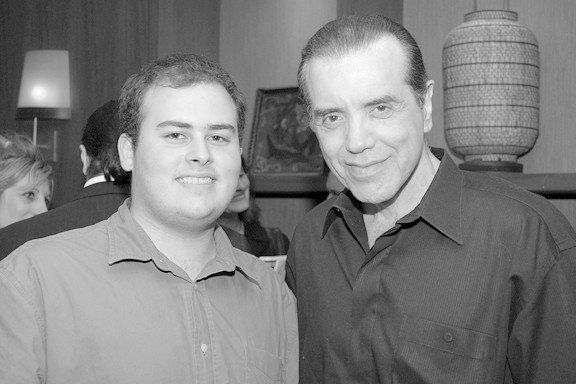
I had the opportunity to meet Palminteri briefly after the ceremony, and he was gracious enough to take a photograph with me:
His affection for Italian-American culture also extends beyond his work as an actor and writer. Palminteri is a genuine connoisseur of fine food and now has two namesake Italian restaurants, one in Manhattan and another in White Plains. I have eaten at the White Plains location many times and consider it one of the best Italian restaurants in Westchester. It may appear to be a small detail alongside a career in film and theater, but it speaks to something essential about Palminteri. He has never separated his work from the family, food, stories and neighborhood culture that formed him.
A BRONX TALE: THE ORIGINAL ONE MAN SHOW is more than a companion piece to the 1993 movie. It is the original heartbeat of the story and the artistic achievement that made everything else possible. Palminteri wrote himself the opportunity that Hollywood would not give him, refused to surrender ownership of his vision, and ultimately transformed a childhood memory into an acclaimed play, a beloved film and a lasting piece of American theater.
For those who have never encountered A BRONX TALE in any form, this is an excellent place to begin. For admirers of the film who have always wondered how one man could create that entire world onstage, the answer is now preserved for them to see. And for those who were fortunate enough to experience Palminteri live, this Blu-ray offers the chance to bring the performance home and revisit it whenever they choose.
A BRONX TALE: THE ORIGINAL ONE MAN SHOW is funny, frightening, intimate and deeply moving. More than three decades after the story first changed Chazz Palminteri’s life, it has lost none of its power. The film adaptation remains a classic, but the one-man show stands proudly beside it as an equally compelling work. This Blu-ray is well worth owning and comes highly recommended.



Comments