


ANIMAL FARM (2026)
Updated: Aug 29
Review by John Larkin
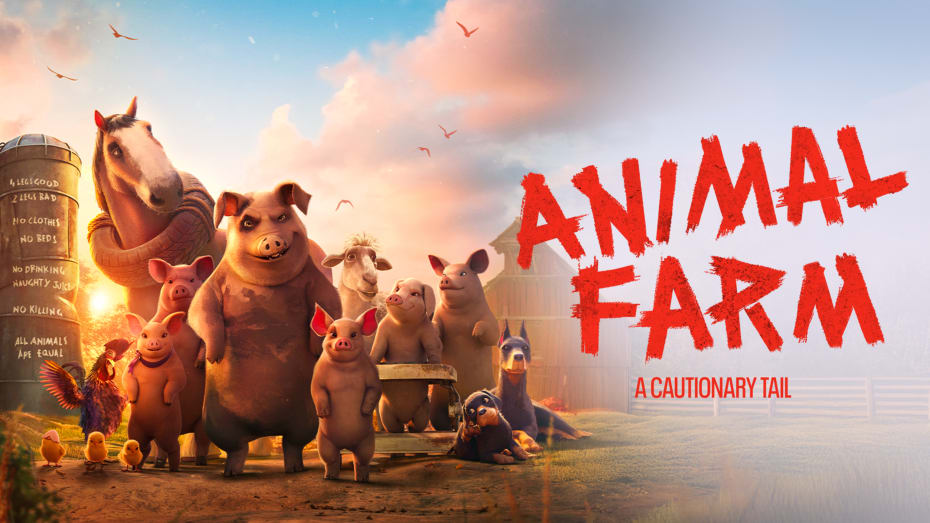
Andy Serkis Brings Orwell to the Barnyard for a New Generation
I did not expect my first major Angel Guild event to involve Andy Serkis, George Orwell, and rentable piglets.
I recently became an Angel Guild member, subscribing not only for myself but for my family. Ironically, that membership, not a traditional press invitation through FILMS IN REVIEW, is what allowed me to attend this special New York premiere event for ANIMAL FARM. But as someone who has spent years covering film, writing about physical media, classic cinema, and the unique places where movie history keeps resurfacing, I was able to parlay that opportunity into coverage for our historic publication.
That, in itself, says something interesting about Angel Studios. Angel is still often thought of as a faith-and-family company, or more bluntly, a Christian film organization. But it has grown well beyond being a niche operation. Its Guild model is built around audience participation, with members watching, voting, and giving feedback on projects before they move forward. Angel’s own materials describe the Guild as a way for members to help decide what projects the studio backs, which gives the company a very different relationship with its audience than the usual top-down studio model.
That made ANIMAL FARM a surprise. Here was George Orwell’s classic political fable, not exactly the first title one associates with contemporary faith-and-family entertainment, arriving under the Angel banner. Even more surprising was the name behind it: Andy Serkis, the motion-capture maverick who changed modern screen acting through Gollum in THE LORD OF THE RINGS films, Caesar in the modern PLANET OF THE APES series, and many other physically transformative performances.
Serkis directs this new animated version of ANIMAL FARM, which Angel is releasing in theaters on May 1, 2026. The film is written by Nicholas Stoller and features a striking voice cast that includes Seth Rogen, Gaten Matarazzo, Woody Harrelson, Laverne Cox, Kieran Culkin, Jim Parsons, Steve Buscemi, Glenn Close, Kathleen Turner, Iman Vellani, and Serkis himself.
The screening I attended was held at the Regal Battery Park, on the highest floor of the building. The space had been decked out in a kind of farm-chic style, complete with a small pig pen where kids could play with real piglets. Who knew one could rent piglets for a movie premiere?
One of the early highlights was seeing Serkis himself taking pictures with guests. He was relaxed, generous, and approachable in a way that can feel increasingly rare at industry events. I was lucky enough to speak with him briefly, and because I could not help myself, I asked him about THE LORD OF THE RINGS: THE HUNT FOR GOLLUM, the new Middle-earth film he is directing and in which he will again play Gollum.
“When do you start shooting?” I asked.
Serkis paused for a second.
“In about eight weeks’ time,” he said.
So there you have it. From the mouth of Gollum himself, filming is close. Warner Bros. has THE LORD OF THE RINGS: THE HUNT FOR GOLLUM set for theatrical release on December 17, 2027, with Serkis directing and reprising his iconic role. Recent reporting has also confirmed returning franchise figures including Ian McKellen as Gandalf and Elijah Wood as Frodo, along with Jamie Dornan taking over the role of Aragorn, identified here as Strider. But that night, before Middle-earth calls him back, Serkis was there for Orwell.
ANIMAL FARM is one of those books that has become so familiar as a school-text title that it can be easy to forget how brutal and precise it is. Orwell’s 1945 novella is most directly rooted in the Russian Revolution, Stalinism, and the betrayal of revolutionary ideals, though its larger warning about corruption, propaganda, and the abuse of power has long outlived that original historical frame.
Serkis has apparently been chasing this adaptation for years. The project has been described as roughly 15 years in the making, and during the Q&A, Serkis spoke about just how long he had been trying to bring this version of the story to the screen. That history matters because this does not feel like a quick IP grab. It feels like a long-gestating attempt to translate a grim political allegory into something younger viewers can actually sit through, process, and hopefully leave an impression on them afterwards.
Whether that translation works depends on what you want from ANIMAL FARM.
If you want a severe, faithful, adult-minded adaptation of Orwell, this is probably not that film. Some critics have already taken issue with Serkis and Stoller’s broader, more family-friendly approach. VARIETY argued that the film trades some of Orwell’s political sharpness for celebrity voices, broader comedy, and kid-targeted energy. That is not an unfair complaint if the measuring stick is the book. Orwell’s ending is meant to chill the blood, not send children home with a hopeful sense that the cycle can be interrupted.
But I think the better question is not whether Serkis’s ANIMAL FARM replaces the book. It does not. The better question is whether it can act as a first encounter with Orwell’s ideas for young audiences, and on that level, I think the film works better than some of the harsher responses suggest.
The movie takes a broad approach to totalitarianism. It is not only about Stalin or communism in the narrow historical sense. It is about how noble language can be weaponized, how slogans replace thought, how leaders rewrite truth, and how a movement built on fairness can decay into hierarchy and fear.
That is the material the film makes accessible. It gives kids a way into ideas like propaganda, inequality, manipulation, and moral cowardice without requiring them to already understand 20th-century political history. It also gives parents a way to talk about those ideas afterward. Why did the animals believe the pigs? Why did the rules keep changing? Why did some animals go along with things they knew were wrong? Why does power make people, or pigs, worse?
The film is clearly not apolitical. Watching the Q&A, and listening to some of the language around the movie, I did feel that the filmmakers were inviting a contemporary reading. There was also an unmistakable Trump-era satirical edge in the room, most visibly in the hat Andy Serkis wore during the event, which viewers can see in the video below. But the movie itself is smart enough not to reduce its allegory to a single topical target. It does not turn Napoleon into a direct caricature of any one modern politician. Instead, it gestures more broadly toward the populist strongman energy that has defined much of recent public life. That restraint is one of its strengths.
For young viewers especially, that matters. Kids do not need a partisan lecture. They need the moral architecture. They need to understand what happens when fairness becomes a slogan instead of a practice, when truth becomes negotiable, when fear becomes a governing tool, and when the loudest animal in the barn decides he owns the place.
On that level, Serkis’s film is less a definitive ANIMAL FARM than an introductory one.
The animation is bright, broad, and expressive, sometimes to a fault. There are moments where the film leans into exaggerated comedy and kid-friendly chaos in a way that may frustrate Orwell purists. But I also understand the choice. This is a PG animated film trying to smuggle a fairly dark political lesson into a package children can follow. The character designs, the voice performances, and the faster comic rhythms all seem aimed at keeping younger viewers engaged long enough for the allegory to land.
The cast helps. Gaten Matarazzo’s Lucky gives the film an audience surrogate, a younger figure caught between competing ideas. Laverne Cox’s Snowball and Seth Rogen’s Napoleon form the ideological split at the center of the farm. Woody Harrelson’s Boxer carries the tragic nobility of the hardworking believer. Jim Parsons, Steve Buscemi, Glenn Close, Kathleen Turner, Iman Vellani, and Serkis himself all add texture around the edges.
The film’s biggest limitation may also be its reason for existing: it wants to be Orwell for kids. That means it cannot be as bitter, as severe, or as politically surgical as the novella. Some of the danger is softened. Some of the satire is broadened. Some of the darkness is made more digestible.
But I am not convinced that makes the film useless. In fact, for the right audience, that may make it useful. Serkis’s ANIMAL FARM may not have the full bite of the book, but for a new generation, it has enough teeth.
Below is a video compilation of footage I was able to capture from the New York event, including the atmosphere, the guests, and a little taste of the barnyard-style premiere experience, to give viewers a sense of what it felt like to be there.


Comments