


THE FRONT (1976) in 4K UHD
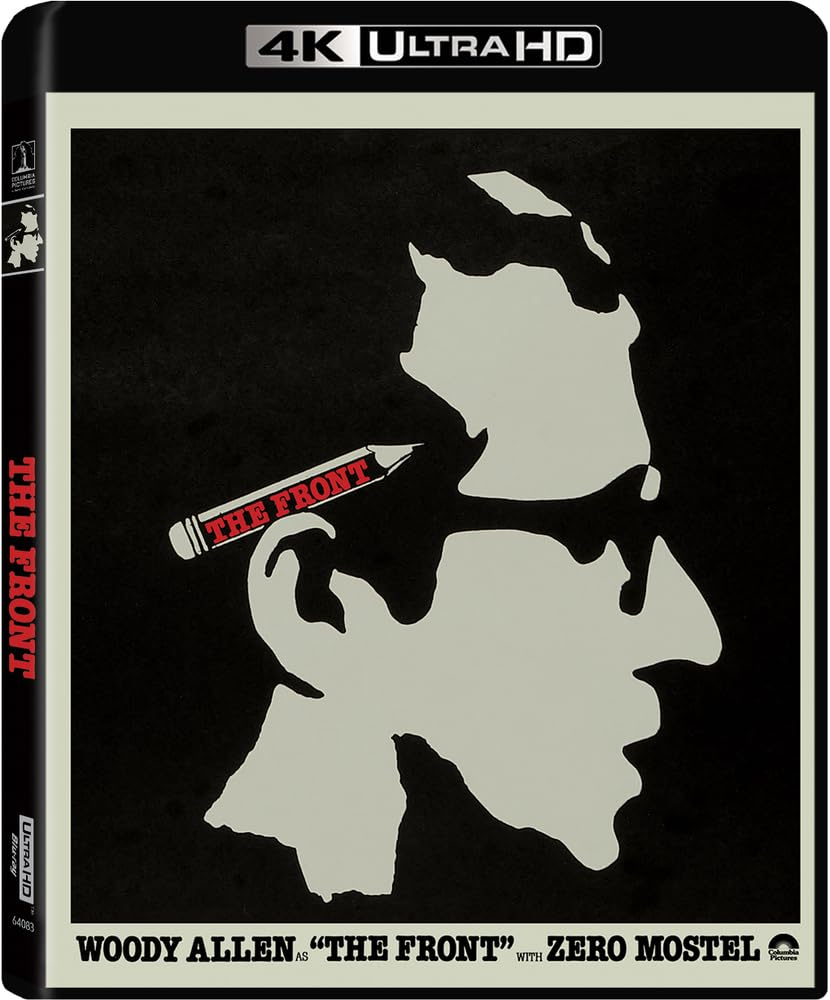
Purchase at MovieZyng.com by clicking the image above
Review by
John Larkin
THE FRONT is an outlier in the canon of WOODY ALLEN as an actor. If most of his screen persona is built around neurotic wit, self-consciousness, romantic unease, and verbal spiraling, THE FRONT asks something very different of him. Here, he strips much of that away. His Howard Prince, a small-time bookie and restaurant cashier, is still recognizable as a Woody Allen character on some level, but he is much less performative, much less charmingly in control, and much more passive, morally hazy, and ordinary. That difference is a major part of what makes the film stand apart, even if the film itself does not always fully capitalize on it.
Released in 1976 and directed by Martin Ritt, THE FRONT remains one of the more direct and accessible films about the effect of blacklisting on writers during the McCarthy era. It begins with a simple, almost darkly comic premise: Howard Prince, a man with little political conviction and even less curiosity about the world around him, agrees to let blacklisted writers use his name so he can make some easy money. At first, the arrangement seems absurd in a way the film knows how to mine effectively. But what starts as a clever hustle slowly becomes something heavier, sadder, and more morally serious.
I am far removed from the McCarthy era. Like many other millennials, I know it mostly through movies, books, and the cultural memory left behind by those who lived through it. So I do not pretend to have some firsthand political insight into the period. But based on what the film presents, and based on the damage that blacklisting clearly did to people’s lives, careers, families, and dignity, it is hard not to sympathize with those whose livelihoods were uprooted by the era’s anti-communist hysteria.
What THE FRONT does well is make that point without turning itself into a lecture. It does not stand on a soapbox insisting that the viewer admire its moral righteousness. It simply shows what happens when fear, conformity, opportunism, and political obsession are allowed to ruin ordinary people.
Zero Mostel’s Hecky Brown gives the film its most painful thread, though his storyline is also where the film’s tonal uncertainty is most evident. Mostel, who had himself been blacklisted, brings an unavoidable personal history to the role. Are we meant to laugh at Hecky’s outlandish behavior, pity him, or feel the horror of watching a once-beloved performer slowly humiliated into collapse? The answer is probably some combination of all three, but the film does not always balance those elements cleanly.
That unevenness helps explain why THE FRONT may have been difficult to market in its time. Here was a movie starring Woody Allen and Zero Mostel, two broadly comic performers, yet it was not really designed to give audiences the kind of comedy they might have expected from either of them. Allen is dialed down and intentionally ordinary. Mostel is heightened, but placed inside a story that becomes increasingly sad and politically haunted. The result is a film that resists easy categorization, though not always in a completely satisfying way. It is not quite severe enough to operate as pure drama, but it is also not consistently funny enough to work as comedy.
One oddly specific thing that jumped out to me as a lifelong STAR WARS fan was a brief exchange involving the HUAC-style investigator pressuring Hecky Brown to find out more about Howard Prince. It was not just the shape of the scene that felt familiar, but the actual phrasing of the dialogue. The moment plays almost uncannily close to the scene in STAR WARS: REVENGE OF THE SITH (2005) where Obi-Wan asks Anakin to spy on Chancellor Palpatine. THE FRONT predates that film by decades, and the contexts are completely different, but the similarity in the wording was hard for me to miss. Could George Lucas have been a fan of this one?
The personal connection behind the film is hard to ignore. Martin Ritt, writer Walter Bernstein, and actors Zero Mostel, Herschel Bernardi, Lloyd Gough, and Joshua Shelley were all blacklisted in the early 1950s, as evidenced by the notations under their names in the closing credits. That detail gives the film the feeling of an old-school cinematic rebuttal to McCarthyism and the political fervor of the time.
But THE FRONT is not especially interested in grandstanding. Its stronger moments come from showing how careers were ruined, how friendships were strained, how dignity was stripped away, and how long it can take for a basically decent but disengaged person to realize that neutrality in a corrupt environment is its own kind of surrender.
There are moments that bring a smile or a chuckle, but the laughs pale in comparison to Allen’s sharper and funnier screen turns elsewhere. Still, the film does give us a truly singular moment in Allen’s screen career: the rare sight of Woody Allen telling someone to “go fuck themselves” on screen. That bluntness cuts through the film’s gentler comic surface and briefly reveals the anger underneath.
The film’s darkly comic charm is also evident in its opening historical montage, which uses real footage to establish the time and place, all set to Frank Sinatra’s “Young at Heart.” The end credits reprise the same swooning song from Ol’ Blue Eyes, giving the film a deceptively warm frame around a story that is, at heart, about fear, compromise, and moral awakening.
Grover Crisp and the team at Sony Pictures continue to turn out what are, in my opinion, the best major studio restorations for 4K releases, consistently dialing in the right amount of grain without sanding away the texture of the original film elements. Their work often feels a level above what some other studios are doing, and this 4K presentation of THE FRONT is no different. Michael Chapman’s cinematography is a major standout, and the disc allows his work to come through with strong clarity and texture while preserving that all-important film grain.
The release also includes a legacy audio commentary with film historians Nick Redman and Julie Kirgo, who moderate a conversation with actress Andrea Marcovicci. Marcovicci is especially upbeat throughout, recalling the experience as the thrill of a lifetime, particularly since THE FRONT was her first film. One of the more charming anecdotes comes when she is asked about kissing Woody Allen on screen. She remembers Allen joking before the take that he was only going to give her “one lip,” because giving her two would have been too overwhelming. It is a funny, very Woody Allen sort of story, and Marcovicci speaks about the experience with obvious affection. The commentary, recorded some years ago before Redman’s passing in 2019, remains a warm and worthwhile supplement.
THE FRONT may not be the funniest Woody Allen performance, nor the most formally daring film about the blacklist, but it remains an unusual and worthwhile piece of work. It is a film made by people who knew exactly what this history cost, and even when its tonal balance wobbles, that firsthand connection gives it a weight it might not otherwise have.


Comments