


MARKED WOMAN (1937)
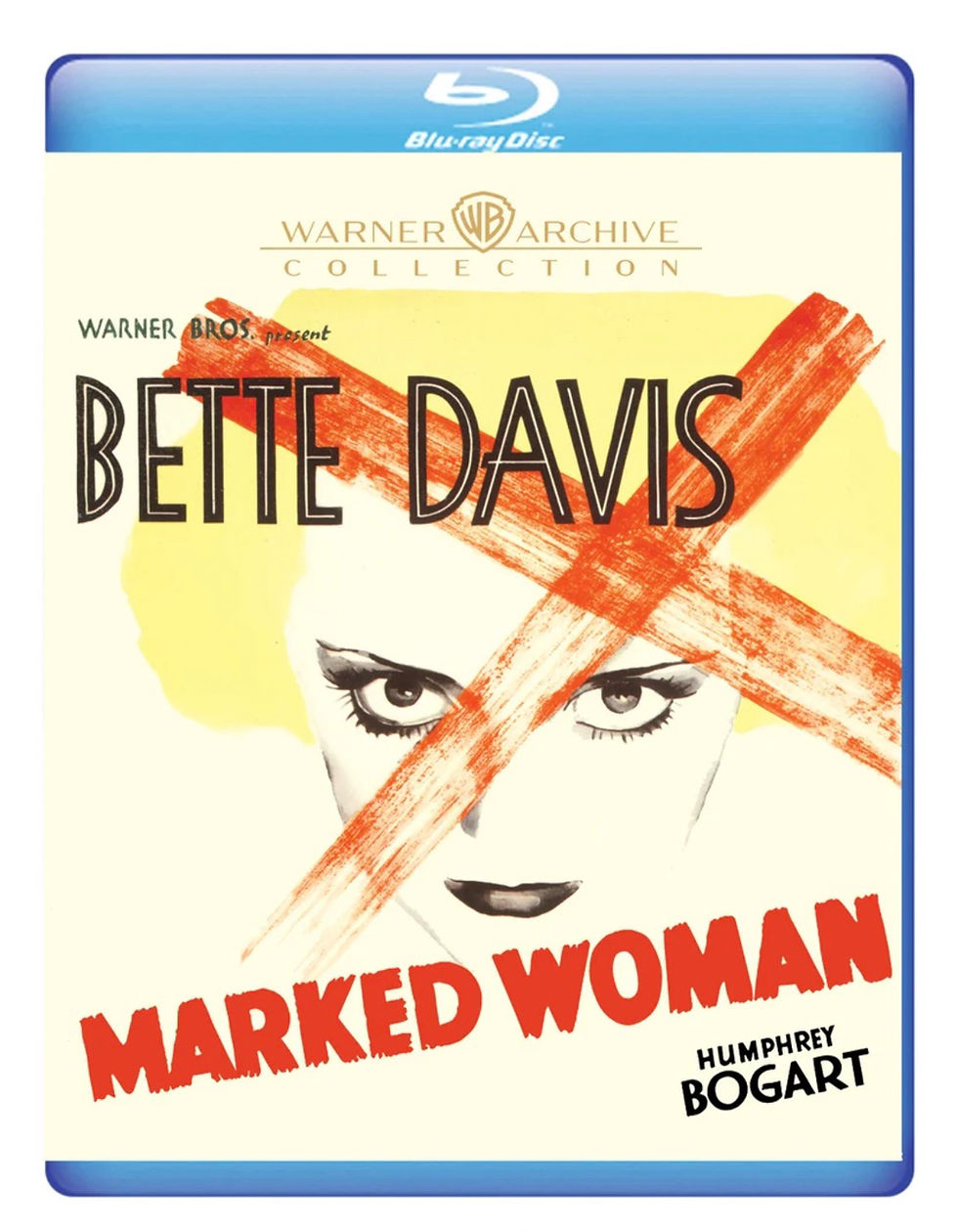
Blu-Ray Review by John Larkin
Lloyd Bacon was the kind of director on whom Warner Bros. could depend to keep its production schedule moving. He could turn out a musical, a comedy or a crime picture with the efficiency the studio demanded, yet his name has never acquired the distinction of contemporaries such as Michael Curtiz or William Wellman. Even two of his most enduring films, 42ND STREET and FOOTLIGHT PARADE, both released in 1933, are more readily associated with Busby Berkeley, whose extraordinary musical numbers tend to eclipse the director responsible for the surrounding drama. Bacon knew how to make a picture work, although the results did not always announce a distinctive personality behind the camera.
MARKED WOMAN (1937), now on Blu-ray from Warner Archive, provides a useful example of both his strengths and his limitations. Bacon handles the material with assurance, keeping the story moving and giving his actors room to establish their characters. The direction is sturdy and generally unobtrusive, but the film’s strongest impressions come from its subject and its leading lady. Bette Davis supplies the anger, resolve and emotional force that make this more than another efficiently assembled studio melodrama.
Davis plays Mary Dwight, one of a group of nightclub hostesses whose livelihood falls under the control of gangster Johnny Vanning, played with threatening arrogance by Eduardo Ciannelli. Mary understands the arrangement well enough to recognize that resistance comes at a price, and her efforts to protect her younger sister, Betty, played by Jane Bryan, give that predicament a personal urgency. The story draws on the prosecution of Lucky Luciano, whose conviction depended on testimony from women working within his prostitution racket. Its most interesting decision is to place those women, rather than the gangster, at the center of the drama.
Humphrey Bogart appears in an unusually upright role for this period of his career as David Graham, the crusading prosecutor seeking to bring Vanning down. There is a certain pleasure in watching the actor on the other side of the law, using his firmness and intensity in the service of a sympathetic character. Graham offers the possibility of justice, but the women must assume the danger of helping him achieve it. Davis remains the film’s driving force, giving Mary a toughness that feels earned by experience rather than simply supplied by the dialogue.
Another distinction is the screenplay, Robert Rossen’s first produced screenwriting credit, shared with Abem Finkel. Rossen would later direct BODY AND SOUL (1947), ALL THE KING’S MEN (1949), which won the Academy Award for Best Picture, and THE HUSTLER (1961). His interest in people struggling within corrupt systems is already evident here. The women are useful to the men who exploit them and to the authorities who need their testimony, while their own security remains precarious. That imbalance gives the film a substance that extends beyond its crime-story machinery.
For all its seriousness, however, MARKED WOMAN makes me wish it had been produced a few years earlier. The Production Code had become firmly enforced by 1937, and censorship required the prostitutes of the source material to become nightclub hostesses. Innuendo and suggestion communicate what the film cannot state outright, but there is a difference between understanding what has been concealed and feeling that a picture has confronted its subject fully. The material calls for a frankness that the film is repeatedly obliged to soften.
This is hardly a gentle story, and its violence against women retains its ugliness.
Nevertheless, compared with the more candid Warner Bros. dramas of the pre-Code years, it can feel restrained at precisely the moments when greater directness would give it more bite. I would have preferred a more overt treatment of the women’s work and the conditions surrounding it. Bacon’s straightforward approach keeps the narrative clear, but it does not consistently turn those restrictions into something more provocative.
Warner Archive has given the film the kind of restoration attention that makes its releases so valuable. The Blu-ray features a new 2026 1080p master drawn from a 4K scan of the original nitrate camera negative, presented in the original 1.37:1 aspect ratio. Published assessments report excellent contrast and grayscale, preserved film grain and a notably clean image. The DTS-HD Master Audio 2.0 mono track accompanies the presentation, with English SDH subtitles also provided.
Supplements include the approximately twelve-minute featurette RIPPED FROM THE HEADLINES, examining Warner Bros.’ approach to topical crime stories, along with the 1937 cartoons PORKY’S HERO AGENCY and SHE WAS AN ACROBAT’S DAUGHTER, both in HD, and a theatrical trailer. MARKED WOMAN may not transform one’s estimation of Bacon as a filmmaker, but it demonstrates the value of his craftsmanship when supported by substantial material and a performer as commanding as Davis. The film’s frustrations lie in how much further its subject might have been taken; its lasting strength is the conviction she brings to what remains.
John Larkin is the Managing Editor of FILMS IN REVIEW, where he has been a contributor since 2008. A filmmaker, writer and editor, he directed the Rondo Hatton Classic Horror Award–nominated documentary FEAR AND LOVE: THE STORY OF THE EXORCIST, an intimate retrospective on the making and enduring legacy of William Friedkin’s 1973 classic. His work for FILMS IN REVIEW spans contemporary cinema, classic Hollywood and physical media.


Comments