


A Hidden Link Between STAR WARS and THE EXORCIST at the 2026 TCM Classic Film Festival
By John Larkin
The best film festivals are not only about the movies you see. They are about the strange, unexpected collisions that happen around them. A restoration leads to a conversation. A screening leads to a memory. A party leads to a piece of movie history that you did not know existed.
That was my experience at this year’s TCM Classic Film Festival, which ran April 30 through May 3 in Hollywood. The 2026 theme was “The World Comes to Hollywood,” a fitting idea for a festival built around the artists, immigrants, craftsmen, and dreamers who shaped American movies from every corner of the globe.
For me, the festival began with one of those screenings that immediately justified the trip: OUT OF THE PAST in its new 4K restoration at the Egyptian Theatre. I had somehow never been inside the Egyptian before and what a venue for the beautifully restored Jacques Tourner noir classic.
A couple of days later, the Egyptian again proved itself to be one of the great moviegoing spaces in the world with COBRA WOMAN, Robert Siodmak’s delirious 1944 Universal adventure starring Maria Montez, Sabu, and Jon Hall. The film is pure Technicolor fantasy, a kind of unapologetic studio-era fever dream, and the Egyptian felt like the ideal venue for it. It is hard to imagine that movie playing better anywhere else.

That is one of the things Los Angeles still has over every other film city in America. New York has great repertory houses and serious movie culture, no question. But Los Angeles has a different relationship to moviegoing. There is a scale to it here, a reverence for the theater as a sacred part of the medium itself. The Egyptian, the Chinese, the Roosevelt, the geography of Hollywood Boulevard, it all contributes to the feeling that you are not just watching film history. You are sitting inside it.
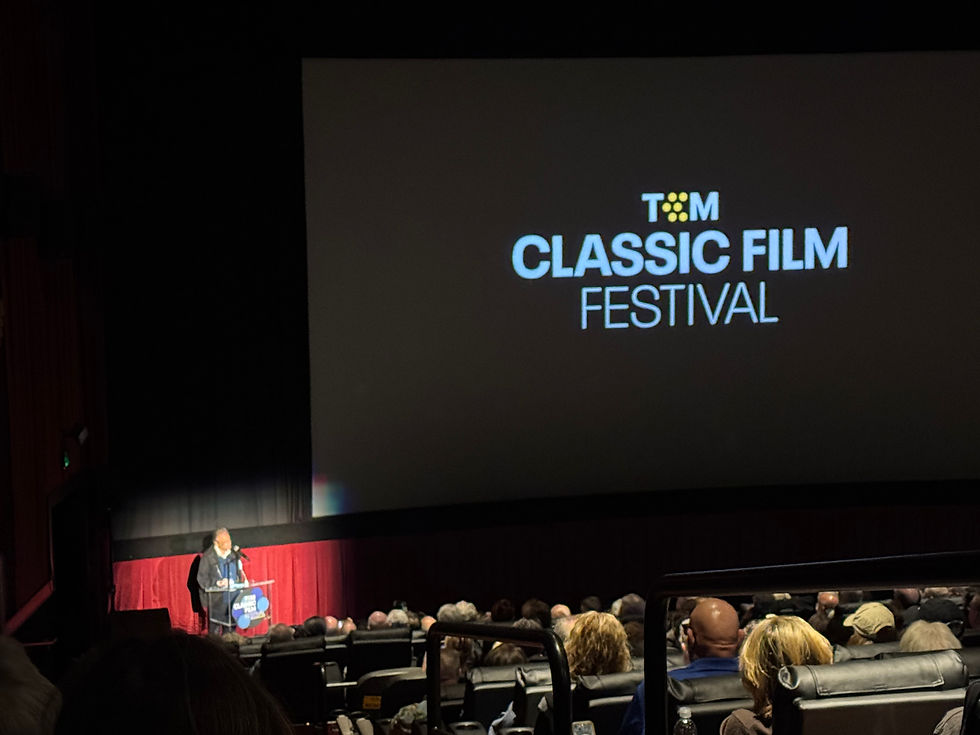
The festival was full of that feeling. Joe Dante introduced THE DAY THE EARTH STOOD STILL, Robert Wise’s 1951 science-fiction landmark, while Oscar-winning sound designer Ben Burtt and visual effects artist Craig Barron presented THE TOWERING INFERNO. Seeing these films on the big screen, with context provided by artists and filmmakers who carry the torch for film history, is what makes TCM’s curation feel vital rather than merely nostalgic.
But the moment I will remember most did not happen during a screening.
It happened at the closing night party.
The closing gathering at the Hollywood Roosevelt had plenty of food, drinks, and the usual relaxed swirl of passholders, guests, hosts, and filmmakers. The famous Tropicana pool was open outside, though most people seemed to remain inside around Club TCM, where the real draw was conversation.
That is where I had a chance to speak with Joe Dante.
Dante is one of those figures who is ubiquitous at Los Angeles film events. He is there because he belongs there, not in a celebrity way, but as someone who genuinely carries film history around with him. We talked for a while about movies, physical media, and the strange joy of rediscovering titles in the right format. One of the highlights of our conversation was his enthusiasm for MONEY FROM HOME, the 1953 Dean Martin and Jerry Lewis comedy shot in 3-D. It was the kind of deep-cut exchange that makes you realize how alive film history still is when the right people are talking about it.
Then came Ben Burtt.
For anyone who grew up loving STAR WARS, Burtt is not just a sound designer. He is one of the architects of that universe. The hum of a lightsaber, the voice of R2-D2, the breathing and mechanics and atmosphere of those films, so much of what we think of as STAR WARS was shaped by his ear. His work is part of the reason that world feels tactile and lived in. You do not simply remember those films visually. You remember how they sound.
I had wanted to speak with Burtt for years, partly because of my own documentary, FEAR AND LOVE: THE STORY OF THE EXORCIST. While making the film, I became increasingly interested in how THE EXORCIST functioned not only as a horror landmark, but as a sound experience. William Friedkin’s film is often discussed for its performances, its imagery, its theology, and its controversy, but the soundscape is just as essential to its power. Mercedes McCambridge’s vocal work as the demon remains one of the most disturbing achievements in screen performance, even though it exists in that strange space between acting, sound design, and possession itself.
Because of that, I had always wondered whether THE EXORCIST had influenced Burtt in any way. My mind had gone specifically to the Emperor’s breathing and vocal presence in STAR WARS: EPISODE III, REVENGE OF THE SITH, but I was open to any connection. I had tried to reach him during the making of my documentary, hoping to ask whether Friedkin’s film or McCambridge’s voice work had ever been part of his thinking.
At the Roosevelt Hotel closing night party, I finally got to ask him. The answer was not what I expected.
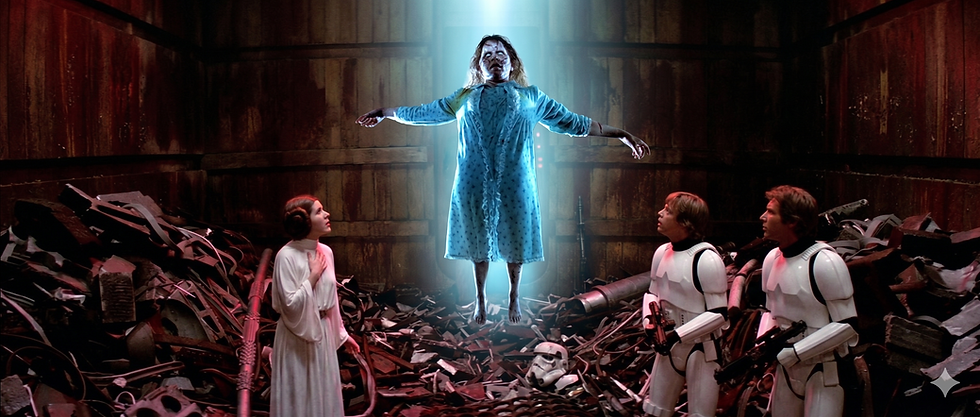
Burtt told me that he had once had access to recordings of Mercedes McCambridge’s voice work. Then he revealed something he said he had never told anyone before: he used some of those recordings in the trash compactor sequence in STAR WARS: A NEW HOPE.
After saying it, he touched my shoulder and laughed to himself, almost as if he could not quite believe he had finally said it out loud.
It was one of those surreal moments where you feel time slow down a little. Here was one of the legendary sound artists in cinema history casually revealing, in the middle of a festival party, a hidden connection between two of the most culturally significant films ever made.
For me, it was especially meaningful. STAR WARS and THE EXORCIST shaped me in completely different ways. One opened up the mythic imagination of childhood. The other introduced me to the power of horror, faith, atmosphere, and psychological disturbance. They could not be more different in tone, yet both changed the culture. Both expanded what movies could do. Both also proved that sound can be as iconic as image.
So there it was: a bridge between them, buried not in a grand mythology or a famous scene of demonic terror, but inside the grimy, mechanical chaos of the Death Star trash compactor.
That is the kind of thing you go to a festival hoping for, even if you do not know it yet.
But the deeper value is proximity. It is being in the same space as the people who made, preserved, studied, and loved these films long enough for the stories to surface. Sometimes those stories are polished and prepared. Sometimes they arrive casually, almost accidentally, over drinks and hors d’oeuvres at the end of a long weekend.
And sometimes, if you are lucky, one of those stories connects STAR WARS to THE EXORCIST.
For a film lover, that is the kind of revelation you do not forget.


Comments